
boxjoy.in is blocked
This page has been blocked by an extension
- Try disabling your extensions.
ERR_BLOCKED_BY_CLIENT
This page has been blocked by an extension
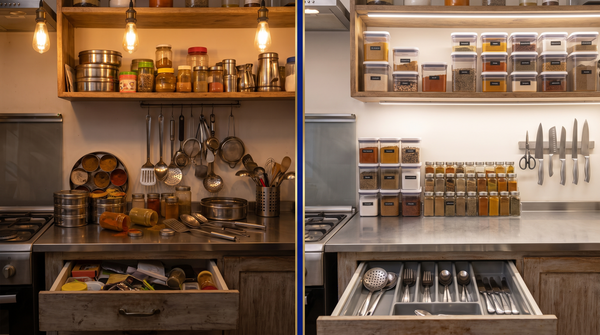
If you've ever spent five minutes hunting for the jeera while your tadka is spluttering away, you already know the chaos a small Indian kitchen can hold. Masala dabba lids that don't match their bases. Pressure cooker whistles living in three different drawers. Steel glasses stacked so high that one wrong move sends them all crashing down.
The good news? You don't need a modular kitchen renovation or a new piece of furniture to fix any of this. You just need a plan — and a little patience on one weekend afternoon.
This sounds dramatic, but it works. Before you organise anything, empty one section of your kitchen completely — one shelf, one drawer, or one cabinet at a time. Don't try to do the whole kitchen in one go. Indian kitchens are dense, and that approach leads to exhaustion halfway through.
As you take things out, sort them into three groups: things you use daily, things you use occasionally (maybe once a week or for specific cooking), and things you barely touch. That fifth kadai you got as a wedding gift? It might be time to let it go — or at least move it out of prime real estate.
This single step will immediately show you how much space you actually have versus how much you thought you had.
Masalas are the heart of Indian cooking and the biggest source of kitchen clutter. Most families accumulate a mix of loose dabbas, store-bought packets that have been half-emptied into other containers, and duplicates they bought because they couldn't find the original.
Here's what actually helps:
Steel dabba stacks are a rite of passage in Indian kitchens. They're practical, durable, and completely impossible to manage once they tip over. The trick is to stop treating them as a single wobbly tower and start treating them as individual items that need a home.
Nest lids separately from the containers. Store lids upright in a small rack or divider — this alone will save you enormous frustration. Group dabbas by size and keep the ones you use most at eye level or on the most accessible shelf.
For utensils, the drawer situation in most Indian kitchens is a jumble of ladles, peelers, bottle openers, and mystery gadgets. Use drawer dividers — simple, inexpensive inserts that create sections — so every item has a designated spot. If your drawer space is limited, a countertop utensil holder near the stove keeps your daily ladles and spatulas easy to grab without cluttering the entire counter.
Small kitchen storage in Indian homes often ignores one of the biggest opportunities: the wall space and the inside of cabinet doors.
Adhesive hooks on the inside of a cabinet door can hold small items like whisks, measuring spoons, or even small pouches. A simple over-the-door rack can add an entire extra layer of storage for things like foil rolls, cling wrap, or cleaning supplies.
If you have open wall space between your counter and your upper cabinets, floating shelves or wall-mounted rails with hooks can hold frequently used pots, pans, or mugs — freeing up cabinet space for everything else.
The BOXJOY Modular Shelf Organiser works particularly well in this zone — it sits neatly on existing shelves and adds a second tier, effectively doubling your storage without touching a single wall.
The cabinet under the sink is one of the most wasted spaces in Indian kitchens. It's usually a dark pile of cleaning supplies, old plastic bags, and forgotten things. A two-tier organiser or a small set of stackable bins can transform this into genuinely useful storage for cleaning products, extra dish soap, or even small appliances you don't use daily.
Organisation only works if it's easy to maintain. Every item in your kitchen should have one specific home — and putting it back should require less effort than leaving it out. If something consistently ends up in the wrong place, that's a sign its assigned home isn't working. Adjust it.
The BOXJOY Drawer Organiser Set is designed with exactly this in mind — flexible, stackable, and built for the real volume of stuff Indian kitchens hold.
A calm, organised kitchen isn't about having less. It's about knowing where everything is. And in a small Indian kitchen full of life and flavour, that makes all the difference.
Search our store
This page has been blocked by an extension


This page has been blocked by an extension